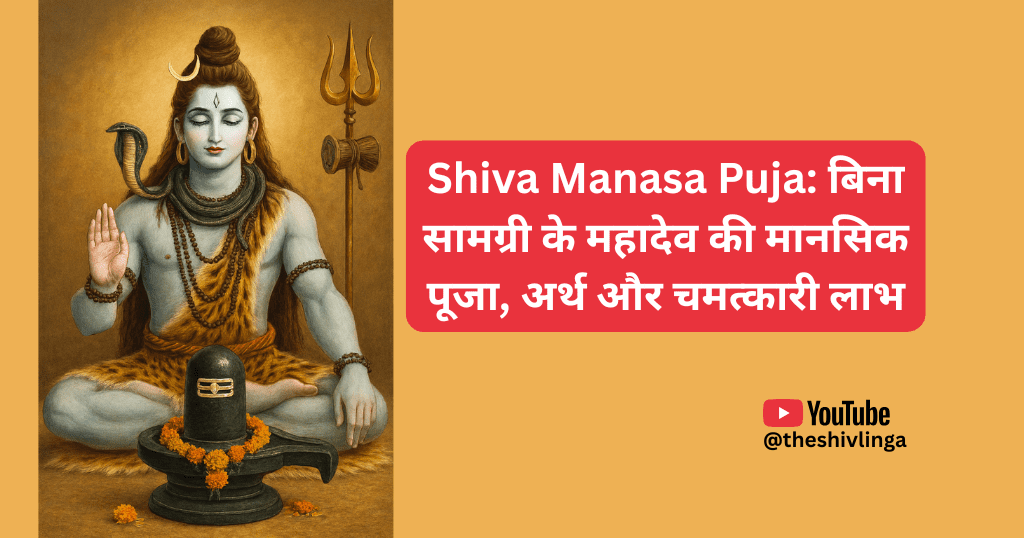
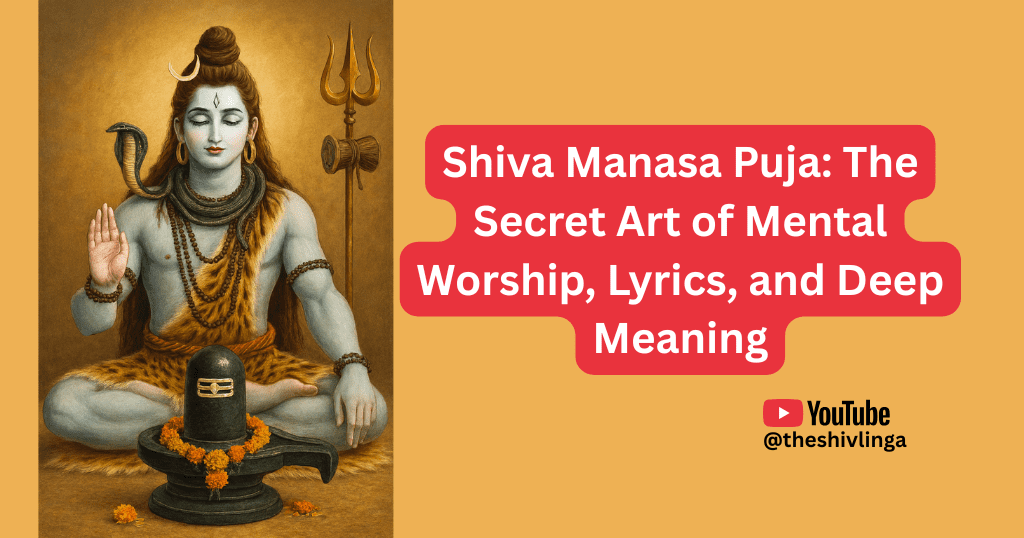
Shiva Manasa Puja: When the Heart Becomes the Temple of Mahadev
In the modern world, we often find ourselves busy, traveling, or in places where we lack the physical materials (flowers, incense, milk) to perform a traditional Shiva Puja. Does this mean we cannot connect with Mahadev? Adi Guru Shankaracharya answered this with a resounding “No” through the creation of the “Shiva Manasa Puja.”
‘Manasa’ means ‘of the mind.’ This stotram is a profound guide to Mental Worship, a practice where the devotee uses the power of imagination and intention to offer the grandest possible worship to Lord Shiva. In the seventh chapter of theshivling.com’s “108 Shiva Stotram Series,” we explore the mystical verses of Shiva Manasa Puja and learn how to worship the Lord of the Universe within the sanctum of our own souls.
The Science and Supremacy of Mental Worship (Manasa Puja)
According to the Shastras, Manasa Puja is considered billions of times more powerful than ‘Bahya Puja’ (external worship). Here is why:
- Purity of Intent: External materials can be tainted, but the offerings of the mind are always pure.
- Infinite Resources: In the physical world, you can only offer what you own. In Manasa Puja, you can offer golden mountains, oceans of nectar, and celestial flowers.
- Advanced Meditation: It requires absolute concentration, making it a high-level practice of Dharana (focus).
॥ Shri Shiva Manasa Puja – Full Lyrics and English Meaning ॥
Verse 1: The Throne and the Bath Ratnaih kalpitamasanam himajalaihsnamam cha divyambaram Nanaratnavibhushitam mrigamadamodankitam chandanam | Jatichampakabilvapatrarachitam pushpam cha dhupam tatha Dipam deva dayanidhe pashupate hritkalpitam grihyatam || 1 ||
Detailed Meaning: O Ocean of Mercy! O Pashupati! I have imagined a throne made of precious gems for You. I bathe You with the cool waters of the Himalayas. I offer You divine garments and jewelry made of various jewels. I apply the fragrance of Musk and Sandalwood. I offer garlands of Jasmine, Champaka, and Bilva leaves. Please accept this incense and the lamp I have lit within my heart.
Verse 2: The Divine Feast (Naivedya) Sauvarne navaratnakhandarachite patre ghritam payasam Bhakshyam panchavidham payodadhiyutam rambhapalam payasam | Shakanamayutam jalam ruchikaram karpurakhandojjvalam Tambulam manasa maya virachitam bhaktya prabho svikuru || 2 ||
Detailed Meaning: O Lord! In a golden bowl studded with the nine gems, I offer You ghee, sweet rice (Payasam), five types of food, milk, curd, and bananas. I offer cool water scented with camphor and a betel leaf (Tambulam). I have prepared this feast mentally with pure devotion; please accept it.
Verse 3: The Royal Splendor Chatram chamarayoryugam vyajanakam chadarshakam nirmalam Vinabherimridangakahalakala gitam cha nrityam tatha | Sashtangam pranatih stutirbahuvidha hyetatsamastam maya Sankalpena samarpitam tava vibho pujam grihana prabho || 3 ||
Detailed Meaning: I offer You a royal umbrella, a pair of whisks (Chamar), a fan, and a clean mirror. I provide the music of the Veena, drums, and Mridangam, along with divine songs and dances. I perform the prostration (Sashtanga Pranama) and sing various hymns. All this I offer through my ‘Sankalpa’ (intention). Please accept my worship.
Verse 4: The Ultimate Surrender Atma tvam girija matih sahacharah pranah shariram griham Puja te vishayopabhogarachana nidra samadhisthitih | Sancharah padayoh pradakshinavidhih stotrani sarva giro Yadyatkarma karomi tattadakhilam shambho tavaradhanam || 4 ||
Philosophical Insight: This is the most celebrated verse in Shiva hymns. The devotee says: “O Shambho! My soul is You. My intellect is Goddess Parvati. My vital breaths (Pranas) are Your attendants. My body is Your temple. My enjoyments are Your worship. My sleep is a state of Samadhi. Everywhere I walk is a circumambulation (Pradakshina) of You. Every word I speak is a hymn in Your praise. Every action I perform is Your worship.”
Verse 5: Seeking Forgiveness Karacharana kritam vakkajayam karmajam va Shravananayanajam va manasam vaparadham | Vihitam-avihitam va sarvametat-kshamasva Jaya jaya karunabdhe shri-mahadeva shambho || 5 ||
10 Profound Benefits: Why Shiva Manasa Puja is Magical
- Instant Anxiety Relief: It forces the mind to shift from worldly stress to a world of divine beauty.
- Spiritual Inclusion: Even those who are physically disabled or hospitalized can perform this supreme worship.
- No Financial Barrier: It proves that God seeks your ‘Bhava’ (emotion), not your bank balance.
- Enhanced Visualization: It trains the brain’s creative centers, improving mental clarity and imagination.
- Ego Dissolution: Verse 4 helps us realize that we are just instruments, and every act is divine.
- Karmic Cleansing: Asking for forgiveness in Verse 5 purifies intentional and unintentional sins.
- Anytime, Anywhere: You can perform this in an office, on a plane, or in bed. It makes worship constant.
- Astral Body Purification: Mental worship purifies the subtle body (Sukshma Sharira), leading to faster spiritual progress.
- Devotion in Scarcity: During travel or illness when physical Puja is impossible, this keeps the connection alive.
- Sayujya Mukti: It creates a habit of seeing Shiva in everything, leading to liberation.
Psychology of “Visualization” in Manasa Puja
Modern psychology suggests that our brain often cannot distinguish between a vividly imagined event and a real one. When you perform Shiva Manasa Puja, your brain releases ‘feel-good’ neurotransmitters like dopamine and serotonin, similar to what you would feel in a grand physical temple. This “Mental Rehearsal” of devotion strengthens the neural pathways of peace and faith.
FAQ – Frequently Asked Questions
- Is Manasa Puja better than physical Puja?
- In many scriptures, yes. Physical Puja is for the body and senses, but Manasa Puja is for the soul.
- How long does it take?
- It can take 5 minutes or 1 hour, depending on how detailed your imagination is.
Conclusion
Shiva Manasa Puja is a masterpiece by Adi Shankaracharya that democratizes divinity. It tells us that we don’t need to go to the mountains to find Shiva; we just need to go within. By practicing this daily, you turn your entire life into a continuous prayer. Stay connected with theshivling.com for more such gems.
Har Har Mahadev!
इसे भी पढ़ें:
शिव चालीसा : शिव भक्ति का अमृत – श्री शिवाय नमस्तुभ्यं
शिवलिंग पर जल कैसे और कब चढ़ाएं ? – श्री शिवाय नमस्तुभ्यं
शिव भगवान की आरती Shiv Aarti Shiv Aarti – श्री शिवाय नमस्तुभ्यं
शिव तांडव स्तोत्रम – श्री शिवाय नमस्तुभ्यं
Our Social Network Connections:
Facebook: Join us on our Facebook for updates
Instagram: Join us on our Instagram updates