Shri Bilvashtakam: The Sacred Hymn of the Triple-Leaved Offering
In the vast traditions of Shiva worship, no ritual is considered complete without the offering of the Bilva leaf (Aegle marmelos), commonly known as Bel Patra. It is said that the roots of the Bilva tree are the abode of Mahadev Himself. To honor this sacred connection between the tree and the Lord, the ancient seers composed the “Shri Bilvashtakam.”
The word ‘Bilvashtakam’ consists of eight verses (Ashtakam) dedicated to the Bilva tree and its leaves. Each verse reminds the devotee that even a single leaf offered with devotion has the power to erase the sins of three lifetimes. In the tenth chapter of theshivling.com’s “108 Shiva Stotram Series,” we bring you the complete Shri Bilvashtakam with its profound English translation and the mystical secrets of the Bilva tree.
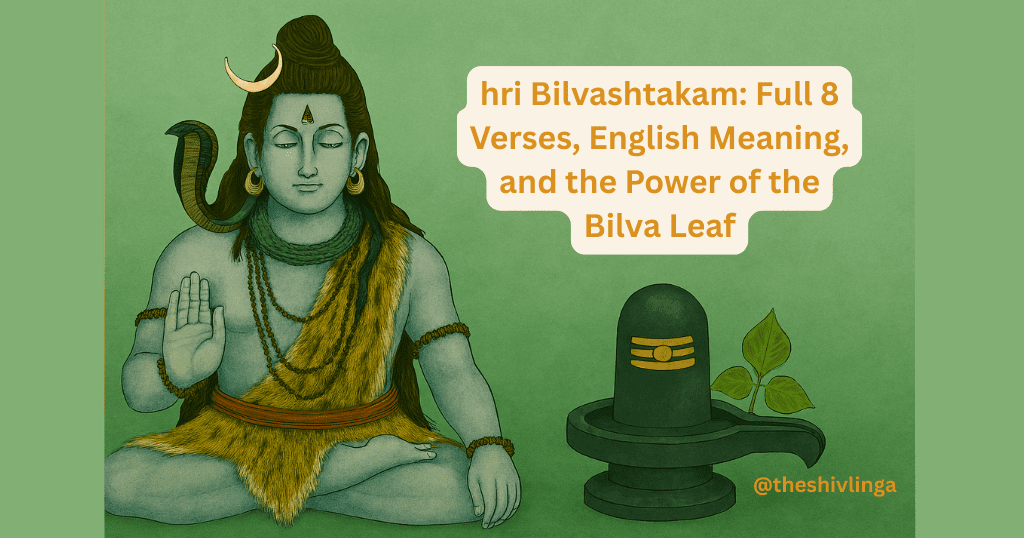
The Symbolism of the Triple Leaf
A single Bilva stalk usually holds three leaflets. This trinity is deeply symbolic in Shaivism:
- The Three Eyes: Representing the three eyes of Lord Shiva.
- The Three Gunas: Representing the balance of Sattva (purity), Rajas (activity), and Tamas (inertia).
- The Three Functions: Representing Creation, Preservation, and Destruction.
- The Three Weapons: Symbolizing the three blades of Shiva’s Trident (Trishula).
॥ Shri Bilvashtakam – Complete 8 Verses with English Meaning ॥
Verse 1: The Triple Manifestation Tridalam Trigunakaram Trinetram Cha Triyayudham | Trijanma Papa Samharam Eka Bilvam Shivarpnam || 1 || Meaning: I offer to Lord Shiva a single Bilva leaf, which has three leaves, represents the three Gunas (Sattva, Rajas, and Tamas), is like the three eyes of Shiva, and resembles His triple-bladed weapon (Trident). This leaf destroys the sins of three births.
Verse 2: The Pure Offering Trishakhair Bilvapatraishcha Hyachidrai Komalai Shubhai | Tava Pujam Karishyami Eka Bilvam Shivarpnam || 2 || Meaning: With Bilva leaves that have three branches, which are whole (without holes), soft, and auspicious, I perform Your worship, O Lord. I offer this single Bilva leaf to Shiva.
Verse 3: The Purifying Presence Darshanam Bilvavrikshasya Sparshanam Papanashanam | Aghora Papa Samharam Eka Bilvam Shivarpnam || 3 || Meaning: The mere sight of the Bilva tree and the act of touching it destroys one’s sins. It even annihilates the most terrible (Aghora) sins. I offer this single Bilva leaf to Shiva.
Verse 4: Equivalence to Holy Pilgrimages Kashikshetra Nivasam Cha Kalabhairava Darshanam | Prayage Maghamasam Cha Eka Bilvam Shivarpnam || 4 || Meaning: The merit obtained by living in the holy city of Kashi, the fruit of having the Darshan of Lord Kalabhairava, and the virtue of bathing in Prayag during the month of Magha—all these are obtained by offering a single Bilva leaf to Shiva.
Verse 5: The Unbroken Devotion Akhanda Bilvapatrena Pujaye-chivam-avyayam | Sarvapapa Vinirmuktah Eka Bilvam Shivarpnam || 5 || Meaning: One who worships the imperishable Lord Shiva with an ‘Akhanda’ (unbroken and whole) Bilva leaf becomes free from all sins. I offer this single Bilva leaf to Shiva.
Verse 6: Merit of Ancient Sacrifices Shaligrama-shila-punyam Yo Dadyat-shivalingake | Somayajya Phalam Tasya Eka Bilvam Shivarpnam || 6 || Meaning: The virtue earned by gifting a sacred Shaligrama stone to a Shivalinga, or the fruits obtained from performing the difficult ‘Somayajya’ sacrifice, is attained by offering a single Bilva leaf. I offer this leaf to Shiva.
Verse 7: Supreme Charity Dantikoti Sahasranam Ashvamedha Shatakratuh | Kotikanya Mahadanam Eka Bilvam Shivarpnam || 7 || Meaning: The massive merit gained by donating thousands of elephants, performing a hundred Ashvamedha sacrifices, or giving away millions of daughters in marriage (Kanya-daanam) is equaled by offering a single Bilva leaf. I offer this leaf to Shiva.
Verse 8: The Birth from Goddess Lakshmi Lakshmyastanu-ta Utpannam Mahadevasya Cha Priyam | Bilvavriksham Prayachami Eka Bilvam Shivarpnam || 8 || Meaning: The Bilva tree was born from the penance of Goddess Lakshmi and is extremely dear to Mahadev. I offer the leaf of this sacred tree to Lord Shiva.
The Metaphysics and Science of the Bilva Tree
The Shri Bilvashtakam is not just a devotional poem; it is a repository of ancient wisdom regarding nature. According to the Shiva Purana, the Bilva tree emerged from the drops of perspiration that fell from Goddess Parvati’s forehead onto the Mandar mountain. Therefore, it is said that Mother Parvati resides in the tree in all her forms—in the roots as Girija, in the trunk as Maheshwari, and in the leaves as Parvati herself.
From a scientific perspective, the Bilva leaf is known for its cooling properties. When Lord Shiva consumed the Halahala poison during the churning of the ocean, His body temperature rose to extreme levels. To cool Him down, the Gods offered Bilva leaves and water. The leaf acts as a natural coolant and possesses anti-bacterial and anti-fungal properties. In Ayurveda, it is called ‘Shri-phal’—the fruit of prosperity and health.
10 Spiritual Benefits of Chanting Shri Bilvashtakam
- Destruction of Triple Birth Sins: As mentioned in the first verse, it cleanses the karmas of your past three lives.
- Attainment of Wealth: Since the tree is a form of Goddess Lakshmi, its worship removes financial obstacles.
- Ancestral Peace: Offering Bilva leaves while reciting this stotram during Amavasya brings peace to one’s ancestors (Pitrus).
- Health and Longevity: The vibrations of this stotram help in healing chronic ailments.
- Success in Rituals: It makes up for any deficiencies in your Shiva Puja.
- Mental Peace: It calms the ‘Agni’ (fire) of anger and lust within the devotee.
- Equivalence to Yagyas: It grants the fruits of ancient Vedic sacrifices like Ashvamedha.
- Protection: It creates a protective aura around the devotee’s home.
- Fulfillment of Vows: Chanting it on Mondays during the month of Shravana manifests hidden desires.
- Moksha (Liberation): Continuous practice leads the devotee to the abode of Shiva (Shivaloka).
The Sacred Etiquette of Offering Bilva Leaves
To ensure your worship on theshivling.com is perfect, follow these rules:
- The Shape: Always choose leaves that are ‘Akhanda’ (unbroken) and have no holes.
- The Side: Always place the smooth, shiny side of the leaf facing down on the Shivalinga.
- The Days: Avoid plucking leaves on Chaturthi, Ashtami, Navami, Chaturdashi, and Amavasya. Use previously plucked leaves instead.
- Reuse: Bilva leaves never become ‘stale’ (Basi). If fresh leaves are unavailable, you can wash and reuse the ones already offered to the Lingam.
Conclusion
Shri Bilvashtakam teaches us that Mahadev is not impressed by expensive jewelry or grand displays, but by the simplicity of nature and the purity of the heart. A single green leaf, offered with the verses of this Ashtakam, is enough to move the Lord of the Universe. Let every leaf you offer be a symbol of your total surrender to the Divine.
Har Har Mahadev!
इसे भी पढ़ें:
शिव चालीसा : शिव भक्ति का अमृत – श्री शिवाय नमस्तुभ्यं
शिवलिंग पर जल कैसे और कब चढ़ाएं ? – श्री शिवाय नमस्तुभ्यं
शिव भगवान की आरती Shiv Aarti Shiv Aarti – श्री शिवाय नमस्तुभ्यं
शिव तांडव स्तोत्रम – श्री शिवाय नमस्तुभ्यं
Our Social Network Connections:
Facebook: Join us on our Facebook for updates
Instagram: Join us on our Instagram updates