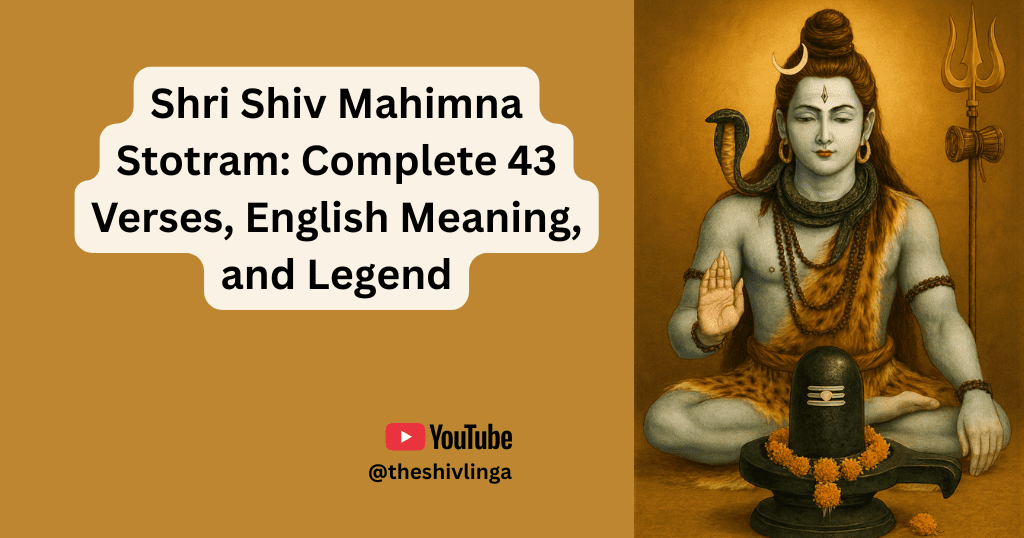
Shri Shiv Mahimna Stotram: The Ultimate Hymn of Glory Composed by Gandharva Pushpadanta
Describing the infinite glory of Lord Shiva is a task that even Goddess Saraswati or the Vedas cannot fully accomplish. Yet, when the heart overflows with devotion, words find their way to express the inexpressible. Among all the hymns dedicated to Mahadev, the Shri Shiv Mahimna Stotram stands at the pinnacle of spiritual literature.
It is not just a poem; it is a blend of profound philosophy, deep repentance, and absolute surrender. In the fourth chapter of theshivling.com’s “108 Shiva Stotram Series,” we bring you the complete Shri Shiv Mahimna Stotram, its fascinating history, the full 43 verses with meanings, and the miraculous benefits of its recitation.
The Legend of Pushpadanta: Why was this Stotram Composed?
The origin story of the Shri Shiv Mahimna Stotram is as captivating as the hymn itself. The composer was Pushpadanta, the king of Gandharvas (celestial musicians) and an ardent devotee of Shiva.
According to the Puranas, a king named Chitra ratha had a beautiful garden filled with rare flowers. Pushpadanta, using his divine power to remain invisible, would steal these flowers every night to offer them to Lord Shiva. The king was frustrated but couldn’t catch the invisible thief. To trap the culprit, the king spread ‘Shiva-Nirmalya’ (sacred remains of Shiva’s offerings like Bilva leaves) across the garden paths.
Pushpadanta, unknowingly stepping on the sacred offerings, committed a sin against Mahadev. Instantly, he lost his divine powers of invisibility. Realizing his mistake and consumed by guilt, he sat down to appease Lord Shiva by singing His glories. The result was the Shri Shiv Mahimna Stotram. Mahadev was so moved by the depth of his devotion that He not only forgave Pushpadanta but also restored his celestial powers.
॥ Shri Shiv Mahimna Stotram – Complete 43 Verses Mahima Stotram with Meaning ॥
Verse 1: Mahimnah param te parama-viduso yady-asadrisi | Stutir-brahmadinam-api tad-avasannas-tvayi girah || Ath-avachyah sarvah svamati-parinama-vadhigrinan | Mam-apyesha stotre hara nirapavadah parikarah || Meaning: O Lord! If a hymn is unworthy because it doesn’t fully describe Your glory, then even Brahma’s words are inadequate. If everyone is allowed to praise You according to their wisdom, then my attempt is also valid.
Verse 2: Atitah panthanam tava cha mahima van-manasayoh | Atad-vyavrttya yam chakitam-abhidhatte shrutirapi || Sa kasya stotavyah katividha-gunah kasya vishayah | Pade t-varvachine patati na manah kasya na vachah || Meaning: Your glory is beyond the reach of speech and mind. Even the Vedas are surprised and can only describe You by saying “Neti-Neti” (Not this, Not this). Who can truly praise You?
Verse 3: Madhusphita vachah paramam-amritam nirmitavatah | Tava brahman kim vag-api suraguror-vismayapadam || Mama tvetam vanim gunakathana-punyena bhavatah | Punamity-arthesmin puramathana buddhir-vyavasita || Meaning: O Destroyer of Pura! You are the creator of the Vedas. Even the speech of Brihaspati (Guru of Gods) cannot surprise You. I am only using my speech to purify myself by singing Your praises.
Verse 4: Tavaishvaryam yat-taj-jagad-udaya-raksha-pralayakrit | Trayivastu vyastam tisrishu gunabhinnasu tanushu || Abhavyanam-asmin varada ramaniya-maramanim | Vihantum vyakroshim vidadhata ihaike jadadhiyah || Meaning: Your divinity creates, protects, and destroys the world through the three Gunas (Sattva, Rajas, Tamas) and three forms (Brahma, Vishnu, Shiva). Only the ignorant find reasons to criticize Your infinite nature.
Verse 5: Kimihah kimkayah sa khalu kimupayas-tribhuvanam | Kimadharo dhata srijati kimupadana iti cha || Atarkyaishvarye tvay-yanavasara-dustho hatadhiyah | Kutarkoyam kanchit mukhara-yati mohaya jagatah || Meaning:* Skeptics ask: What is His body? What are His means? On what basis did He create the world? These foolish questions only serve to confuse the world about Your unfathomable power.
Verse 6: Ajanmano lokah kimavayavavanto-pi jagatam | Adhishtataram kim bhavavidhir-anadritya bhavati || Anisho va kuryad bhuvanajanane kah parikaro | Yato mandas-tvam prat-yamaravara sansherata ime || Meaning: Can the worlds exist without a creator? Can an incompetent being create this universe? Fools doubt You, the Supreme Lord, because they cannot see the truth.
Verse 7 (The Universal Path): Trayi sankhyam yogah pashupatimatam vaishnavamiti | Prabhinne prasthane paramidam-adah pathyamiti cha || Ruchinam vaichitryad-rijukutila nanapathajusham | Nrinam-eko gamyas-tvamasi payasam-arnava iva || Meaning: Various paths lead to the same goal. Due to different tastes, men follow different paths (Vedas, Sankhya, Yoga, etc.), but all reach You, just as all rivers reach the ocean.
Verse 8: Mahokshah khatvangam parashurajinam bhasma phaninah | Kapalam cheti-yattava varada tantropakaranam || Surastam tam riddhim dadhati tu bhavad-bhru-pranihitam | Na hi svatmaramam vishaya-mrigatrishna bhramayati || Meaning: A bull, a trident, an axe, ashes, and a skull—these are Your simple possessions. Yet, the Gods enjoy riches granted by a mere movement of Your eyebrow. Worldly desires cannot distract one who is rooted in the Self.
Verse 9: Dhruvam kashchit sarvam sakalam-aparastvadhruvam-idam | Paro dhrauvya-dhrauvye jagati gadati vyastavishaye || Samaste-pyetashmin puramathana tair-vismita iva | Stuvann-jihremi tvam na khalu nanu dhrishta mukharata || Meaning: Philosophers debate whether the world is eternal or temporary. O Destroyer of Pura! I am not confused by them; I simply praise You, even if it seems bold.
Verse 10: Tavaishvaryam yatnad-yadupari virinchir-hariradhah | Parich-chettum yatavanal-amaladhas-kandhavapushah || Tato bhakti-shraddha-bhara-guru-grinadbhyam girisha yat | Svayam tasthe tabhyam tava kimanuvrittir-na phalati || Meaning: When Brahma flew up and Vishnu went down to find the ends of Your pillar of fire, they failed. But when they praised You with faith and devotion, You appeared before them. Does devotion to You ever go unrewarded?
Verse 11: Ayatnad-asadya tribhuvanam-avairavyatikaram | Dashasyo yad-bahun-abhrita rana-kandupa-ravashan || Shirah-padmashreni-rachita-charanambhoruha-baleh | Sthirayas-tvad-bhaktes-tripurahara visphurjitam-idam || Meaning: The power of the ten-headed Ravana, who conquered the three worlds, was actually the result of his firm devotion to You, for which he offered his heads like lotuses at Your feet.
Verse 12: Amushya tvatseva-prakatita-balishtham ranabhujam | Balush-chakre banah parijanavidheya-tribhuvanah || Na tach-chitram tasmin varivasitari tvach-charanayoh | Na kasyapy-unnatyai bhavati shirasas-tvay-yavanatih || Meaning: Because Bana-asura worshipped Your feet, he became so powerful that the entire universe served him. It is no surprise; bowing one’s head to You always leads to greatness.
Verse 13: Akanda-brahmanda-kshaya-chakita-devasurakripa- | Vidheyasyasid-yastripurahara visham sanhritavatah || Sa kalmashah kanthe tava na kurute na shriyam-aho | Vikaropi shlaghyo bhuvana-bhaya-bhanga-vyasaninah || Meaning: The blue stain on Your throat from swallowing the poison to save the universe is not a blemish. It is a glorious ornament for one who removes the fear of the world.
Verse 14: Asiddhartha naiva kvachidapi sadevasura-nare | Nivartante nityam jagati jayino yasya vishikhah || Sa pashyan-nisha tv-amitarasura-sadharanam-abhut | Smarah smartavyatma na hi vashishu pathyah paribhavah || Meaning: The God of Love (Kamadeva), whose arrows never fail, was turned to ash when he looked at You as an ordinary God. Insulting a master of senses like You always leads to ruin.
Verse 15: Mahi padaghatad vrajati sahasa sanshayapadam | Padam vishnor-bhramyad bhuja-parigha-rugna-graha-ganam || Muhur-dyaur-dausthyam yaty-anibhrita-jata-tadita-tata | Jagad-rakshayai tvam natasi nanu vamaiva vibhuta || Meaning: When You dance to save the world, the earth trembles under Your feet, the stars are scattered by Your arms, and the heavens are struck by Your matted hair. Your power is truly paradoxical.
Verse 16: Viyadvyapi taragana-gunita-phenodgam-aruchih | Pravaho varam yah prishata-laghu-drishtah shirasi te || Jagad-dvipakaram jaladhivalayam tena kritam-iti | Anenaivonneyam dhritamahima divyam tava vapuh || Meaning: The celestial river (Ganga) that spreads across the sky looks like a tiny drop on Your head. This same river creates the vast oceans surrounding the continents. This alone shows Your divine greatness.
Verse 17: Rathah kshoni yanta shatadhritir-agendro dhanuratho | Rathange chandrarkau rathacharana-panih shara iti || Didhakshoste koyam tripura-trinam-adambara-vidhih | Vidheyaih kridantyo na khalu paratantrah prabhudhiyah || Meaning: For You to destroy the city of Tripura, the earth was the chariot, Brahma the driver, the mountain the bow, and Vishnu the arrow. Why such a display for a task as small as burning a blade of grass? It was just Your divine play.
Verse 18: Hariste sahasram kamala balim-adhaya padayoh | Yade-kone tasmin nijam-udaharannetra-kamalam || Gato bhaktyudrekah parinatim-asau chakravapusha | Trayanam rakshayai tripurahara jagarti jagatam || Meaning: When Lord Vishnu offered a thousand lotuses to You and found one missing, He offered His own eye as a lotus. This extreme devotion was rewarded with the Sudarshana Chakra, which protects the three worlds.
Verse 19: Kratau supte jagrat tvamasi phalayoge kratumatam | Kva karma pradhvastam phalati purusharadhana-mrite || Atastvam samprekshya kratushu phaladana-pratibhuvam | Shrutau shraddham badhva dridha-parikarah karmasu janah || Meaning: You are the one who grants the fruits of sacrifices. Without worshipping You, no action yields results. Therefore, people perform rituals with faith, knowing You are the granter of rewards.
Verse 20: Kriyadaksho dakshah kratupatir-adhishas-tanubhritam | Rishinam-artvijyam sharanada sadasyah suraganah || Kratu-bhranshas-tvattah kratuphala-vidhana-vyasaninah | Dhruvam kartuh shraddhavidhura-mabhichara-ya hi makhah || Meaning: Even though Daksha was skilled and had great sages and gods at his sacrifice, the ritual was destroyed because he lacked faith in You. Sacrifices without devotion become a cause for ruin.
Verse 21: Prajanatham natha prasabham-abhikam svam duhitaram | Gatam rohid-bhutam riramayishum-rishyasya vapusha || Dhanushpaner-yatam divam-api sapatrakritam-amum | Trasantam te-dyapi tyajati na mrigavyadha-rabhasah || Meaning: When Brahma lusted after His own daughter, You took the form of a hunter to punish Him. Even today, Brahma (as a deer) is chased across the sky by Your arrow.
Verse 22: Svalavany-ashansa dhrita-dhanusham-ahnaya trinavat | Purah plushtam drishtva puramathana pushpayudham-api || Yadi strainam devi yamanirata dehardha-ghatanat | Avaiti tvamad-dha bata varada mugdha yuvatayah || Meaning: Because You share Your body with Parvati, some might think You are controlled by women. But they forget You turned the God of Love to ash like a blade of grass. Only the ignorant misunderstand Your self-control.
Verse 23: Shmashaneshv-akrida smarahara pishachah sahacharah | Chita-bhasmalepah sragapi nrikaroti-parikarah || Amangalyam shilam tava bhavatu namaivam-akhilam | Tathapi smartrinam varada paramam mangalam-asi || Meaning: You play in crematoriums, Your friends are ghosts, and You wear a garland of skulls. All this may seem inauspicious, O Granter of Boons, but for those who remember You, You are the source of supreme auspiciousness.
Verse 24: Manah pratyak-chitte savidham-avidhayatta-marutah | Prahrishyad-romanah pramada-salilotsangita-drishah || Yadalok-yahlada hrada iva nimajyamrita-maye | Dadhaty-antastattvam kimapi yaminas-tat kila bhavan || Meaning: Yogis control their breath and mind to see a divine light within themselves. They experience a lake of nectar and joy. That truth they find is none other than You.
Verse 25: Tvam-arkas-tvam somas-tvamasi pavanas-tvam hutavahah | Tvam-apas-tvam vyoma tvamu dharanir-atma tvamiti cha || Parich-chinnam-evam tvayi parinata bibhrati giram | Na vidmas-tat-tattvam vayamiha tu yat-tvam na bhavasi || Meaning: People say You are the Sun, Moon, Air, Fire, Water, Ether, Earth, and the Soul. But in reality, there is nothing in this universe that is NOT You.
Verse 26: Trayim tisro vrittis-tribhuvanam-atho trin-api suran | Akaradyair-varnais-tribhir-abhidadhat tirna-vikriti || Turiyam te dhama dhvanibhir-avarundhanam-anubhih | Samastam vyastam tvam sharanada grinat-yom-iti padam || Meaning: The sacred word “OM” represents the three worlds, the three Vedas, and the three Gods. It also represents Your fourth (Turiya) transcendental state. “OM” is Your complete name.
Verse 27: Bhavah sharvo rudrah pashupatira-thograh sahamahan | Tatha bhimeshanav-iti yad-abhidhanashtakam-idam || Amushmin pratyekam pravicharati deva shrutirapi | Priyayasmaidhamne pranihita-namasyosmi bhavate || Meaning: I bow to Your eight names—Bhava, Sarva, Rudra, Pashupati, Ugra, Mahadeva, Bhima, and Ishana—which are praised in the Vedas.
Verse 28: Namo nedishthaya priyadava davishthaya cha namah | Namah khodishthaya smarahara mahishthaya cha namah || Namah varshishthaya trinayana yavishthaya cha namah | Namah sarvasmai te tadidam-atisarvaya cha namah || Meaning: Salutations to You who are nearest and farthest, smallest and largest, oldest and youngest. Salutations to You who are everything and beyond everything.
Verse 29: Bahula-rajase vishvotpattau bhavaya namo namah | Prabala-tamase tat-samhare haraya namo namah || Jana-sukhakrite sattvodriktau mridaya namo namah | Pramahasi pade nistraigunyai shivaya namo namah || Meaning: I bow to You as Brahma (Rajas) for creation, as Shiva (Tamas) for destruction, as Vishnu (Sattva) for the happiness of people, and as the Fourth state beyond all qualities.
Verse 30: Krisha-parinati chetah kleshavashyam kva chedam | Kva cha tava gunasimollanghini shashvad-riddhih || Iti chakitam-amandikritya mam bhaktir-ardhad | Varada charanayoste vakya-pushpopaharam || Meaning: My mind is limited and troubled, while Your glory is infinite. Yet, my devotion emboldens me to offer this bouquet of words at Your feet.
Verse 31: Asita-giri-samam syat kajjalam sindhu-patre | Sura-taru-vara-shakha lekhani patram-urvi || Likhati yadi grihitva sharada sarvakalam | Tadapi tava gunanam-isha param na yati || Meaning: If the black mountain were ink, the ocean the inkpot, the divine tree the pen, and the earth the paper, and if Goddess Saraswati wrote for eternity, she could not reach the end of Your qualities.
Verse 32: Asura-sura-munindrair-architasyendu-mauleh | Grathita-guna-mahimno nirgunas-yeshvarasya || Sakala-guna-varishthah pushpadant-abhidhanah | Ruchiram-alaghuvrittaih stotram-etach-chakara || Meaning: This beautiful hymn to the Moon-crested Lord was composed by Pushpadanta, the best of Gandharvas.
Verse 33: Aharahar-anavadyam dhurjateh stotram-etat | Pathati parama-bhaktya shuddhachittah puman yah || Sa bhavati shivaloke rudra-tulyas-tathatra | Prachuratara-dhanayuh putravan kirtimanshcha || Meaning: Anyone who recites this hymn to Lord Shiva daily with devotion will become like Shiva in Shivaloka, and on earth, will be blessed with wealth, long life, children, and fame.
Verse 34: Maheshanna-paro devo mahimno napara stutih | Aghoranna-paro mantro nasti tattvam guroh param || Meaning: There is no God greater than Shiva, no hymn greater than Mahimna Stotram, no mantra greater than Aghora, and no truth greater than the Guru.
Verse 35: Diksha danam tapastirtham jnanam yagadikaah kriyah | Mahimnastava pathasya kalam narhanti shodashim || Meaning: Initiation, charity, penance, pilgrimage, knowledge, and sacrifices do not equal even one-sixteenth of the benefit of reciting this Mahimna Stotram.
Verse 36: Kusumadashana-nama sarva-gandharva-rajah | Shashidhara-vara-mauler-devadevasya dasah || Sa khalu nija-mahimno bhrashta evasya roshat | Stavanam-idam-akarshid divya-divyam mahimnah || Meaning: Pushpadanta, the king of Gandharvas and servant of Shiva, lost his powers due to the Lord’s anger. To regain them, he composed this divine hymn.
Verse 37: Suravara-muni-pujyam svarga-mokshaika-hetum | Pathati yadi manushyah pranjalir-nanyachetah || Vrajati shiva-samipam kinnaraih stuyamanah | Stavanam-idam-amogham pushpadanta-pranitam || Meaning: If a person recites this hymn with folded hands and focused mind, they will reach Lord Shiva and be praised even by celestial beings.
Verse 38: Asamaptam-idam stotram punyam gandharva-bhashitam | Anaupamyam manohari sarvam-ishvara-varnanam || Meaning: Here ends the sacred and incomparable hymn composed by the Gandharva, describing the Supreme Lord.
Verse 39: Ityesha vangmayi puja shrimach-chankara-padayoh | Arpita tena deveshah priyatam me sadashivah || Meaning: This floral offering of words is placed at the feet of Lord Shankara. May the Lord of Gods be pleased with me.
Verse 40: Tava tattvam na janami kidrashosi maheshvara | Yadrashosi mahadeva tadrashaya namo namah || Meaning: I do not know Your true essence or what You are like, O Maheshwara. I simply bow to You, whatever Your form may be.
Verse 41: Ekakalam dvikalam va trikalam yah pathen-narah | Sarvapapa-vinirmuktah shivaloke mahiyate || Meaning: Whoever recites this once, twice, or thrice a day is freed from all sins and attains Shivaloka.
Verse 42: Shri-pushpadanta-mukha-pankaja-nirgatena | Stotrena yah pathati yah pathati pathati shivabhakti-muktena || Tasya sarvapapa-vinasho bhavati || Meaning: One who recites this hymn emerging from the lotus-mouth of Pushpadanta, filled with devotion, will be cleansed of all sins.
Verse 43: ॥ Iti Shri Pushpadanta Virachitam Shiva Mahimna Stotram Samaptam ॥ Meaning: Thus ends the Shri Shiva Mahimna Stotram composed by Pushpadanta.
॥ Shri Shiv Mahimna Stotram – Complete 43 Verses with Meaning in Shorts॥
Verse 1: Mahimnah param te parama-viduso yady-asadrisi | Stutir-brahmadinam-api tad-avasannas-tvayi girah || Ath-avachyah sarvah svamati-parinama-vadhigrinan | Mam-apyesha stotre hara nirapavadah parikarah || 1 || Meaning: O Lord Shiva! If a hymn of praise is unworthy because it doesn’t fully describe Your infinite glory, then even the words of Brahma are inadequate. However, if everyone is allowed to praise You according to their intellect, then my attempt to sing Your glory is equally justified.
Verse 2-6 (The Unfathomable Nature of Shiva): In these verses, Pushpadanta explains that Shiva is beyond the reach of the mind and speech. He questions the skeptics who try to analyze the “how” and “why” of creation, stating that the divine play of Mahadev is beyond logic.
Verse 7 (The Unity of Paths): Trayi sankhyam yogah pashupati-matam vaishnavam-iti | Prabhinne prasthane param-idam-adah pathyam-iti cha || Ruchinam vaichitryad-riju-kutila nanapatha-jusham | Nrinam-eko gamyas-tvam-asi payasam-arnava iva || 7 || Meaning: Different paths like Vedas, Sankhya, Yoga, and Vaishnavism suggest various ways. Due to different tastes, people follow straight or crooked paths, but ultimately, all reach You, just as all rivers eventually reach the ocean.
Verse 13 (The Blue Throat): This verse glorifies the sacrifice of Shiva during the churning of the ocean (Samudra Manthan). The blue stain on His throat, caused by the poison Halahala, is not a blemish but a mark of His supreme compassion for the universe.
Verse 23 (The Paradox of Shiva’s Form): Pushpadanta describes Shiva’s lifestyle—living in crematoriums, smeared with ash, wearing skulls. While these seem ‘inauspicious’ to the world, for those who meditate on Him, Shiva is the source of ultimate auspiciousness (Mangalam).
Verse 31 (The Most Famous Verse): Asita-giri-samam syat kajjalam sindhu-patre | Sura-taru-vara-shakha lekhani patram-urvi || Likhati yadi grihitva sharada sarvakalam | Tadapi tava gunanam-isha param na yati || 31 || Meaning: Even if the Black Mountain were the ink, the ocean the inkpot, the branch of the Kalpavriksha the pen, and the Earth the paper; if Goddess Saraswati herself were to write forever, she could never finish describing Your infinite qualities.
Verses 32-43 (Pushpadanta’s Introduction & Phalashruti): The concluding verses describe the composer, Pushpadanta, and state the benefits of this hymn. It promises that anyone who recites this stotram with a pure heart daily will be blessed with wealth, fame, children, and ultimate liberation (Rudraloka).
Miraculous Benefits: Why Recite Shri Shiv Mahimna Stotram?
Reciting the Shri Shiv Mahimna Stotram provides benefits that are unparalleled in spiritual practice:
- Restoration of Lost Status: Just as Pushpadanta regained his lost powers, this stotram helps devotees regain lost reputation, wealth, or confidence.
- Expiation of Sins: It is believed that chanting this hymn washes away even the most deep-seated sins.
- Mental Clarity: The rhythm and vibration of the 43 verses act as a psychological detox, removing stress and anxiety.
- Planetary Alignment: It is particularly effective for those suffering from the ill effects of Saturn (Shani) and Rahu-Ketu.
- Ultimate Liberation: The Phalashruti promises that the sincere seeker will merge with the Shiva consciousness at the end of their life.
How to Properly Practice Shri Shiv Mahimna Stotram?
- Best Time: Monday mornings, Pradosham evenings, or the night of Maha Shivratri.
- The Altar: Sit facing North (the direction of Kailash). Light a Ghee lamp and offer Bilva leaves.
- The Chanting: Since the Sanskrit is dense, listen to the audio while reading the text for the first few times to ensure correct pronunciation.
- Full Version: Ensure you read all 43 verses. Skipping the Phalashruti (the results) is often discouraged in Vedic traditions.
Conclusion
The Shri Shiv Mahimna Stotram is more than just a prayer; it is a gateway to the divine. Whether you are seeking forgiveness for mistakes or longing for spiritual heights, these 43 verses of Pushpadanta are your perfect companion. At theshivling.com, we encourage you to make this stotram a part of your daily spiritual diet and witness the grace of Mahadev.
Har Har Mahadev! Om Namah Shivaya!
इसे भी पढ़ें:
- FAQs Shiv Related
- Download Shiv Ringtone Now
- शिवलिंग पर जल कैसे और कब चढ़ाएं ? – श्री शिवाय नमस्तुभ्यं
- शिव भगवान की आरती Shiv Aarti Shiv Aarti – श्री शिवाय नमस्तुभ्यं
- शिव तांडव स्तोत्रम – श्री शिवाय नमस्तुभ्यं
- शिव चालीसा : शिव भक्ति का अमृत – श्री शिवाय नमस्तुभ्यं
Our Social Network Connections:
Facebook: Join us on our Facebook for updates
Instagram: Join us on our Instagram updates